
If you have a box of old photos, you've likely wondered if they can ever look new again. You might be asking, “what are the benefits of using AI for photo restoration?” compared to traditional methods.
In the past, you had to mail your precious originals to a lab or spend hundreds of dollars on professional editors. Today, AI has turned a weeks-long process into a matter of seconds.
Here is why AI is the ultimate tool for preserving your family legacy.
What Is AI Photo Restoration?
AI photo restoration uses advanced algorithms trained on millions of images to repair and enhance damaged photos.
Instead of simply applying filters, AI can:
- reconstruct missing details
- sharpen blurred faces
- restore textures and contrast
If you want a deeper explanation, read our guide on How AI Photo Restoration Works.
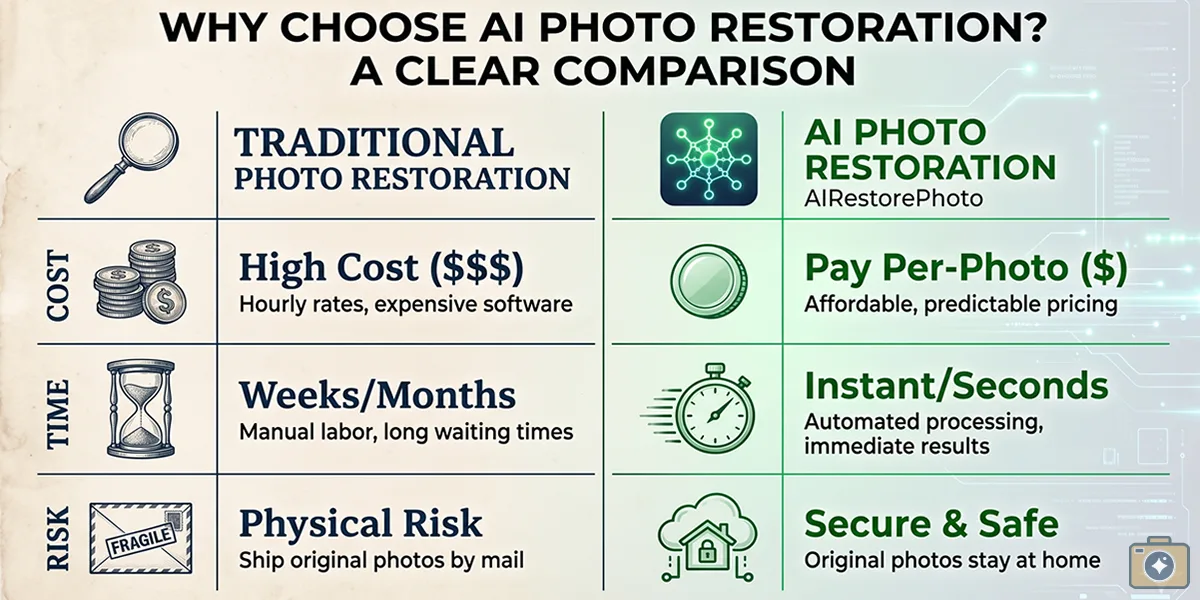
Benefit 1: Restore Photos Without Risking the Original
In the past, restoring photos often meant mailing your only copy to a lab.
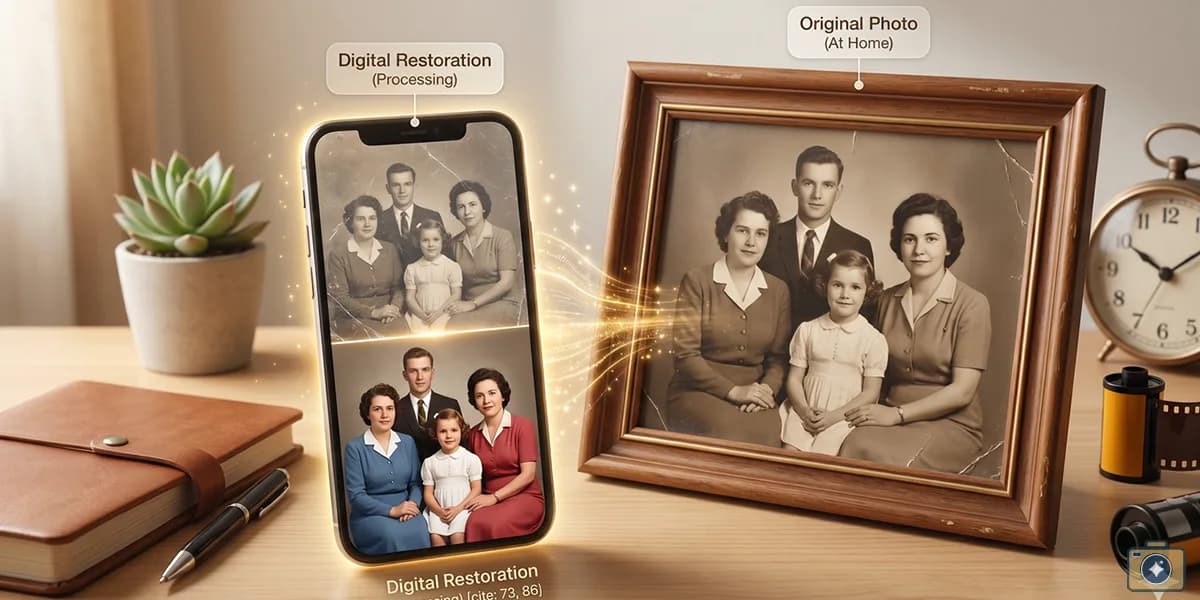
With AI, your original photo never leaves your home. You simply:
- scan or photograph it
- upload a digital copy
- restore it safely
Your physical photo stays protected at all times.
Benefit 2: Restore Old Photos Without Expensive Editing
Traditional photo restoration can be costly because it requires hours of manual work.
AI changes this completely. Because the process is automated:
- restoration happens instantly
- costs are significantly lower
- you can restore only the photos you care about
This makes photo restoration accessible to everyone — not just professionals.
Benefit 3: See Instant Results Instead of Waiting Days
One of the biggest advantages of AI is speed.
Traditional restoration takes days or weeks. AI restoration takes seconds.
You can instantly preview your restored image and decide if you want to keep it.
This dramatically improves the experience and removes uncertainty.
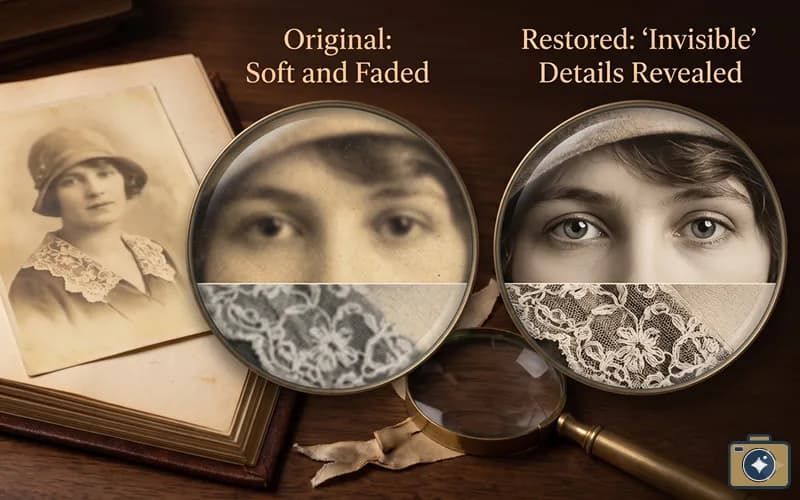
Benefit 4: Bring Back “Invisible” Details
Old photos often lose clarity over time. Faces become soft, and small details disappear.
AI can:
- sharpen facial features
- enhance textures (clothing, hair, backgrounds)
- improve overall clarity
In many cases, you'll see details you didn't even realize were still there.
Don't let your memories fade away
Benefit 5: Restore Large Photo Collections Easily
If you have dozens — or even hundreds — of old photos, traditional restoration becomes impractical.
AI makes it scalable. You can:
- restore multiple photos quickly
- process images one by one without high cost
- gradually build a complete digital archive
This is ideal for families with large photo collections.
Benefit 6: No Technical Skills Required
You don't need to learn Photoshop or editing tools.
Our AI photo restoration tool is designed to be simple:
- Upload your photo
- Let the AI process it
- Download the result
Anyone can use it, regardless of experience.
Benefit 7: Preserve Your Family Memories for the Future
Photos are not just images — they are part of your family's history.
Over time, physical photos degrade due to:
- light exposure
- humidity
- aging materials
By restoring and digitizing them now, you ensure they remain visible for future generations.
You're not just fixing photos — you're preserving memories.
How to Prepare Your Photos for the Best Restoration Results
To get the most out of these benefits, the quality of your digital “scan” matters. You don't need a professional scanner; you can use your smartphone.
- Find Natural Light: Avoid using a flash, which creates a glare on glossy old photos.
- Stay Flat: Lay the photo on a flat surface and hold your phone directly above it.
- Clean the Lens: A quick wipe of your phone camera lens can significantly improve the AI's ability to see details.
Why You Should Restore Your Photos Now
Old photos don't just fade — they disappear.
Every year, more detail is lost to time. By restoring your photos today, you:
- preserve important memories
- protect them from further damage
- make them easy to share with family
The sooner you start, the more you can save. Restore your photo today.
WHY IT MATTERS
Want to understand why restoring family photos is so important?
Read our guide: “Why Restoring Family Photos Matters.”